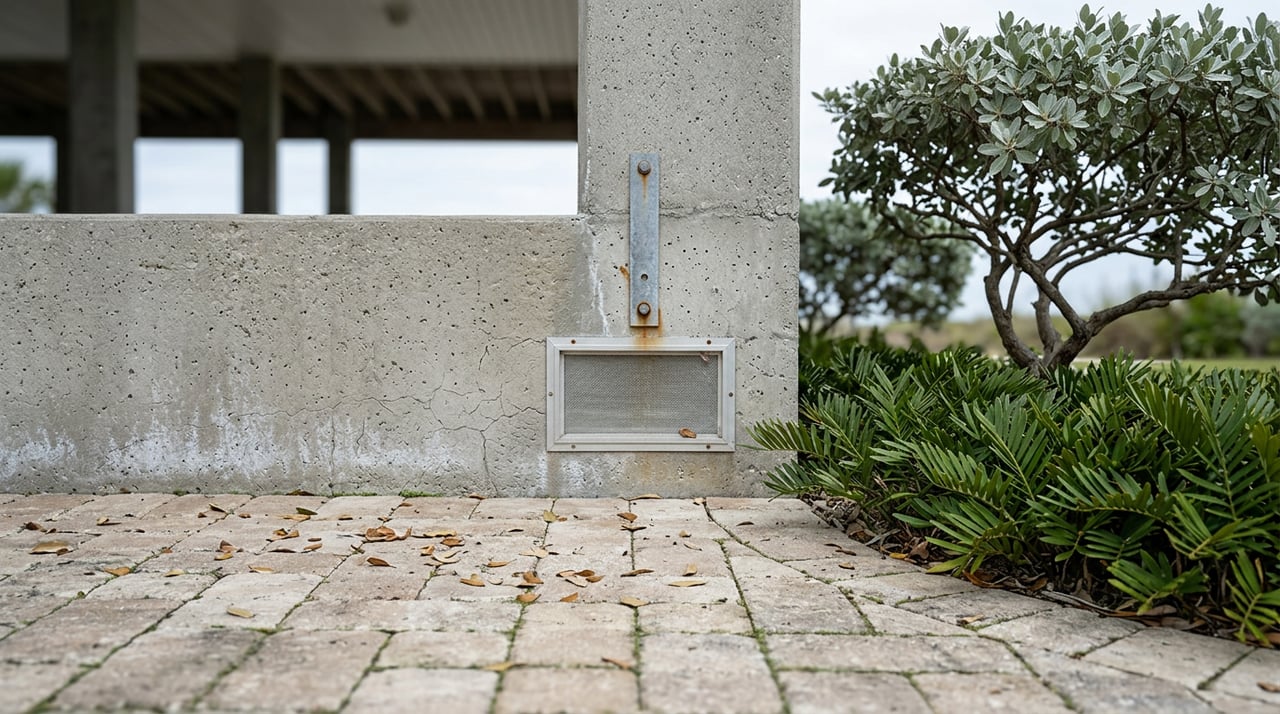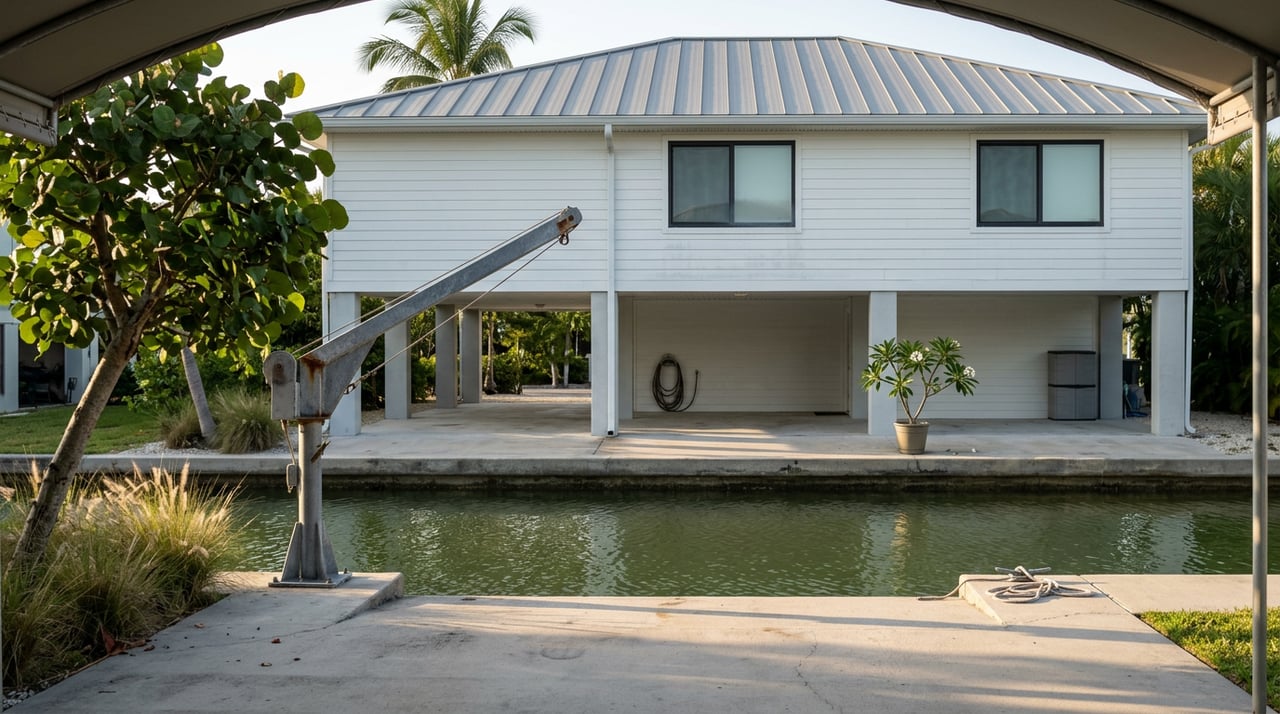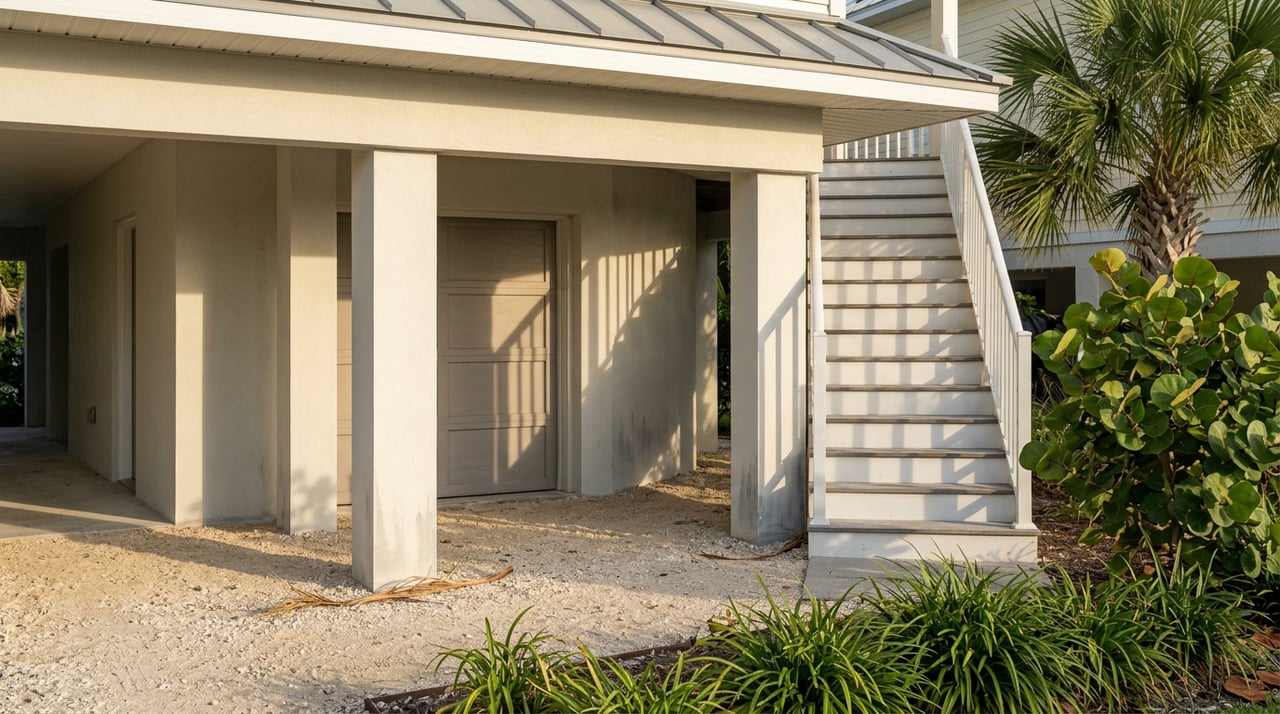
For more than twenty years, a house on Plantation Key operated under a rule that didn't apply one mile south in the Village of Islamorada. If you owned an elevated home in unincorporated Monroe County, which covers Tavernier and Plantation Key, the space enclosed beneath your house for storage could not exceed 299 square feet. Cross into an incorporated municipality and that ceiling disappeared. Same stilt-house architecture, same flood zone, different rulebook depending on which side of an invisible boundary your pilings sat on.
That asymmetry ended on February 4, 2026, when Monroe County's code amendments took effect. The county struck the 299-square-foot cap, the requirement for an inspection at the time of sale, and a related floodplain certificate of compliance program. If you're selling or buying an elevated home in Tavernier or Plantation Key right now, the headline sounds like less oversight. The mechanics say otherwise. The county didn't remove the paper trail. It moved it from a single moment, the sale, to a document that now travels with the property permanently.
The Rule That Applied Nowhere Else in the Keys
The 299-square-foot limit traces back to 2002, when FEMA placed Monroe County on probation for not doing enough to stop homeowners from converting downstairs storage into living space. The county's fix, adopted in 2004 as a remedial plan, capped enclosed storage at 299 square feet and layered on a mandatory inspection every time an elevated home changed hands. It kept the county compliant with the National Flood Insurance Program, which today backs more than 11,000 policies across Monroe County. It also meant that unincorporated Monroe County, alone among Keys communities, ran a stricter storage rule than its incorporated neighbors.
By 2023, local real estate agents, contractors, and title companies had told county officials the rule was creating real friction at closing tables. Sellers with modest downstairs storage areas, common in neighborhoods like Plantation Key Colony and Sunshine Estates, faced an extra inspection step that buyers elsewhere in the Keys never encountered. That pressure is what pushed the county to seek FEMA's sign-off on eliminating the remedial plan altogether.
What Actually Changed on February 4
FEMA's letter of support cleared the way, and the Board of County Commissioners voted to strike three things from county code: the square-footage cap, the point-of-sale inspection requirement, and the floodplain certificate of compliance program. The county's Growth Management Director described the change as giving homeowners more flexibility while keeping the county compliant with federal flood rules.
Here's what that looks like in practice.
| Before Feb. 4, 2026 | After Feb. 4, 2026 | |
|---|---|---|
| Enclosed storage size | Capped at 299 sq ft | No size cap |
| Inspection at sale | Required | Eliminated |
| Certificate of compliance program | Required | Eliminated |
| Habitable use of downstairs space | Prohibited | Still prohibited |
| Non-conversion agreement for expansion | N/A | Required, recorded |
| FEMA compliance spot checks | Ongoing | Ongoing |
Three rows changed. Two didn't.
The Paperwork That Didn't Go Away
Downstairs enclosures still cannot become habitable space. That restriction comes from federal floodplain regulations, not county discretion, and no amount of local rulemaking touches it. What's new is the mechanism that enforces it going forward.
Anyone who wants to expand storage space beyond the old 299-square-foot line still has to pull a permit, and that permit comes with a condition: sign a recorded non-conversion agreement documenting exactly how the space is allowed to be used. That agreement attaches to the property's public record, which means a future buyer's title search will surface it the way it would surface an easement or a lien.
The point-of-sale inspection is gone, but FEMA hasn't stepped back from oversight entirely. Its floodplain management team still conducts compliance reviews on a random sample of Monroe County structures roughly every six months. Those visits aren't tied to a sale, an owner request, or a listing date. They happen on FEMA's own schedule, independent of the transaction calendar.
The county didn't loosen its watch on downstairs enclosures. It changed when and how that watch happens, from a single point-in-time checkpoint to a standing document plus an ongoing federal spot-check system.
What This Means If You're Selling an Elevated Home in Tavernier Right Now
Tavernier's housing stock leans heavily on the stilt-house format, from the Historic District's older elevated cottages to newer construction in Sunshine Estates and Plantation Key Colony. Homes here carried an average value of roughly $750,800 as of May 2026, with a median 81 days on market that same month, a market active enough that title issues surface regularly rather than theoretically.
The practical shift for sellers is this. Without a mandatory pre-sale inspection, nobody is automatically checking whether the enclosed space under your house matches what county records say it should be. That responsibility now sits with due diligence rather than with a scheduled county visit. A buyer's agent, appraiser, or closing attorney who's paying attention will want to see whether a non-conversion agreement exists for the property, and if it does, whether the actual built space matches what that agreement describes.
If you built out storage space before February 2026 without going through the permitting process, the removal of the size cap doesn't retroactively legalize it. It just means the path to legalizing it now runs through a permit application and a recorded agreement rather than staying stuck at 299 square feet. Sellers who address that gap before listing avoid a conversation that used to happen automatically at a scheduled inspection and now only happens if someone asks.
For buyers, the question worth asking isn't whether the home passed an inspection. It's whether a non-conversion agreement is on file, what it permits, and whether the space under the house matches it.
A Few Questions Worth Asking Before You List or Offer
Does this rule apply in Islamorada or Key Largo too? It depends on incorporation, not proximity. Key Largo is unincorporated Monroe County, the same as Tavernier and Plantation Key, so the same rule change applies there. The Village of Islamorada is incorporated and sets its own building rules, along with Marathon and Key West, so this particular change does not apply within those city limits.
Can I now finish out the space under my house as a den or guest room? No. Habitable use of downstairs enclosures remains prohibited under federal floodplain regulations regardless of square footage. The size cap is gone. The use restriction is not.
What if my home already has more than 299 square feet of enclosed space downstairs? That space existed outside the old rule before February 2026. The cap's removal opens a path to permit and legalize it going forward, but that requires an application and a recorded non-conversion agreement rather than automatic grandfathering.
Rules like this one rarely make headlines, but they show up at closing tables, in title searches, and in the questions a sharp buyer's agent asks before writing an offer. If you're weighing a sale or a purchase of an elevated home in Tavernier or Plantation Key and want a second set of eyes on what's actually documented versus what's actually built, Karan Moeller has spent decades in Islamorada and the Upper Keys, including building three homes of her own here. Let's Connect before you list or make an offer.